


Mono Potassium Phosphate (MKP): Scientific Application Guide, Common Mistakes and Synergistic Mixing Solutions
Category: Agricultural Technology / Fertilizer Application Guide
Abstract: Mono Potassium Phosphate (MKP) is a high-efficiency, fully water-soluble phosphorus and potassium fertilizer widely adopted in modern precision agriculture. Despite its excellent crop enhancement effects, unscientific application often leads to unsatisfactory results, such as stunted plant growth and decreased flowering and fruiting rate. This article systematically sorts out MKP’s correct usage, typical application errors, key precautions and compatible mixing schemes to help farmers maximize fertilizer efficiency and crop yield and quality.
The biggest misconception among growers is regarding MKP as a universal fertilizer suitable for all growth stages of crops. In fact, MKP has a single nutrient orientation and obvious targeted application scenarios.
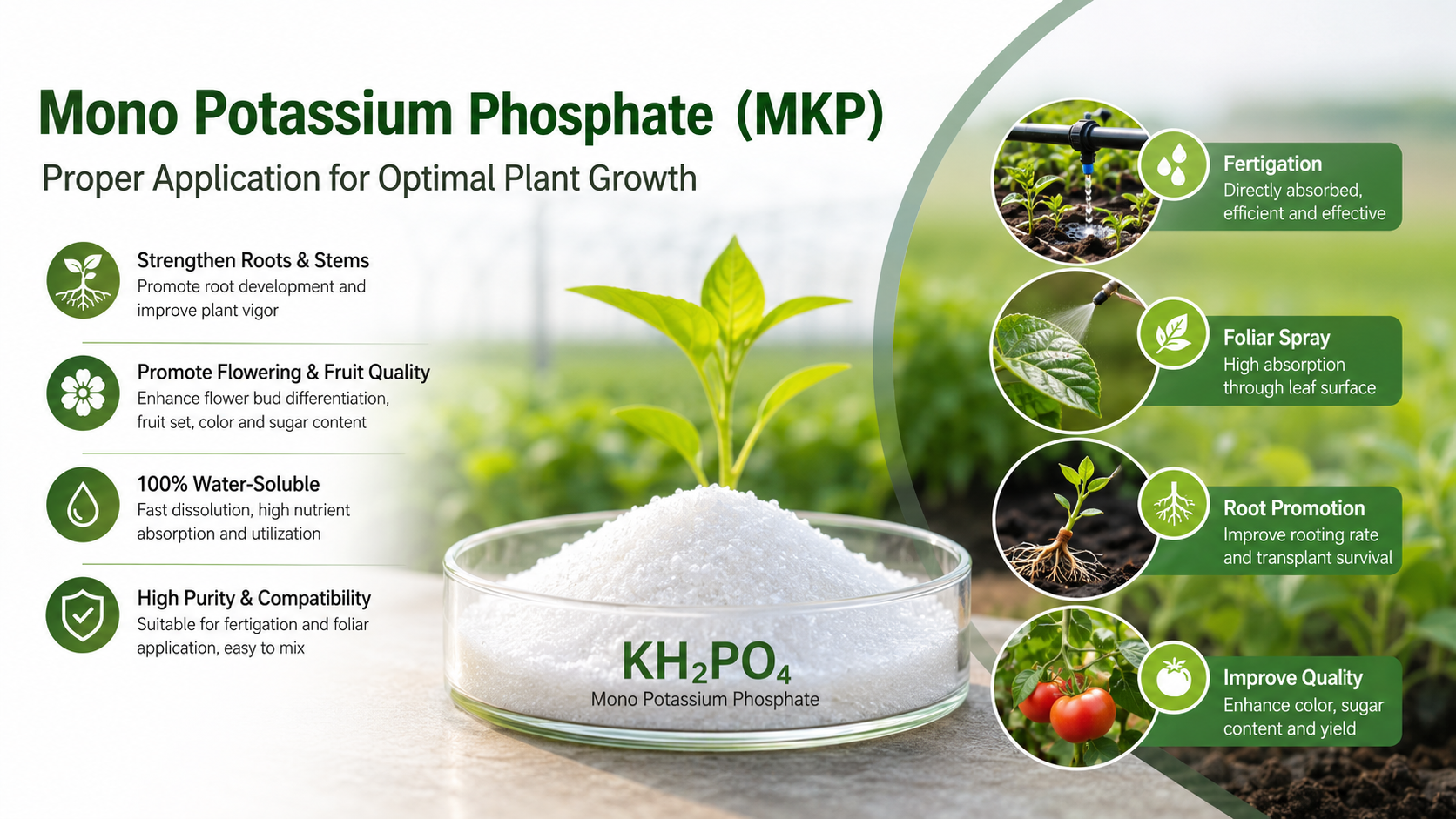
Common Mistakes in MKP Application
MKP mainly provides phosphorus and potassium elements, focusing on promoting crop root development, stem strengthening and flowering & fruiting reproductive growth, with no obvious effect on promoting vegetative growth (leaf and seedling growth). Excessive or misplaced application will cause phosphorus accumulation in the soil, block the absorption of medium and trace elements by crops, and inhibit normal plant growth.
Applicable scenarios: MKP is only suitable for crops with sufficient nitrogen supply and healthy vegetative growth, and is mainly used to assist flowering, fruit setting and fruit quality improvement.
Scientific MKP Application Methods for Maximum Fertilizer Efficiency
The application mode of MKP should be reasonably selected according to the development degree of crop root systems to ensure rapid and full nutrient absorption.
1. Root Drenching
Applicable crops: Crops with well-developed and robust root systems.
Root drenching allows MKP nutrients to directly contact the root system and be quickly absorbed and utilized by crops. It can effectively strengthen root activity, thicken plant stems, improve crop stress resistance, and make the whole plant grow robustly, laying a solid foundation for later flowering and fruiting.
2. Foliar Spraying
Applicable crops: Seedlings or plants with weak, underdeveloped root systems and poor root absorption capacity.
When spraying, ensure full coverage of the upper and lower surfaces of leaves. The leaf back has denser stomata and stronger nutrient absorption capacity, which can significantly improve fertilizer utilization rate and avoid waste. Foliar spraying features rapid absorption and quick effect, which can quickly supplement phosphorus and potassium nutrients for crops.
Key Precautions for Safe and Efficient MKP Use
To avoid fertilizer damage, resource waste and reduced efficacy, growers must strictly abide by the following application specifications:
1. Strictly control incompatible mixing
Do not mix MKP with ferrous phosphate, copper sulfate, carbendazim, mancozeb, cuprous oxide, aluminum sulfate and manganese sulfate. Chemical reactions will occur after mixing, which will reduce fertilizer and pesticide efficacy, and even cause phytotoxicity to crops.
2. Pay attention to field ventilation after foliar spraying
Keep good ventilation in the planting area after spraying, so that the leaf surface moisture can evaporate and dry quickly. Long-term wet leaf surface will easily induce leaf diseases and rot, affecting crop growth.
3. Avoid direct spraying on flowers and fruits
High-concentration MKP solution will damage the delicate tissue of flowers and young fruits, easily cause fruit rot and flower drop, and reduce the fruiting rate and commodity value of crops.
4. Fully dissolve before use
Before spraying or root drenching, fully stir and shake the MKP solution to ensure complete dissolution of particles. Undissolved impurities will block the spray nozzle, resulting in uneven nutrient distribution and inconsistent crop growth.
Efficient Synergistic Tank-Mixing Solutions
Reasonable mixing of MKP with compatible fertilizers and pesticides can produce synergistic effects, significantly improve crop growth status and increase yield and quality.
1. Cutting Rooting Promotion Scheme
Dilute MKP with water at a ratio of 1:100 to 1:300, and soak crop cuttings for 30 minutes before cutting propagation. This method can effectively activate cutting vitality, accelerate root differentiation, and greatly improve the survival rate of cutting rooting.
2. MKP + Paclobutrazol (Flower Bud Differentiation)
Mix and apply according to the recommended dosage of the two products. The combination of MKP and paclobutrazol has an obvious synergistic effect, which can effectively promote crop flower bud differentiation, increase the number of flower buds, improve flowering quality, and reduce flower and fruit drop.
3. MKP + Urea (Balanced Growth)
The compound use of MKP and urea can simultaneously supplement nitrogen, phosphorus and potassium three major elements, realize balanced nutrient supply, promote efficient absorption and utilization of nutrients by crops, coordinate vegetative growth and reproductive growth, and make crops grow more vigorously.
4. MKP + Glucose (Quality Improvement)
Foliar spraying of MKP mixed with glucose can effectively promote sugar accumulation in fruits, improve fruit coloring uniformity, significantly improve fruit appearance and taste, and enhance the overall commodity quality of fruits.
Conclusion
As a high-efficiency phosphorus-potassium fertilizer, MKP plays an irreplaceable role in improving crop root activity, promoting flowering and fruiting, and optimizing fruit quality. Only by adopting scientific application methods, avoiding mismatched application scenarios and incompatible mixing, and selecting targeted synergistic schemes can we give full play to the maximum efficacy of MKP fertilizer.
Standardized and scientific MKP application can not only greatly improve nutrient utilization efficiency and reduce planting costs, but also effectively increase crop yield and quality, bringing stable and higher economic benefits to global growers.