


68% Nitric Acid: Properties, Applications and Safety Instructions
68% nitric acid possesses balanced corrosivity and oxidizability, which makes it the most widely used nitric acid concentration grade for industrial scenarios.
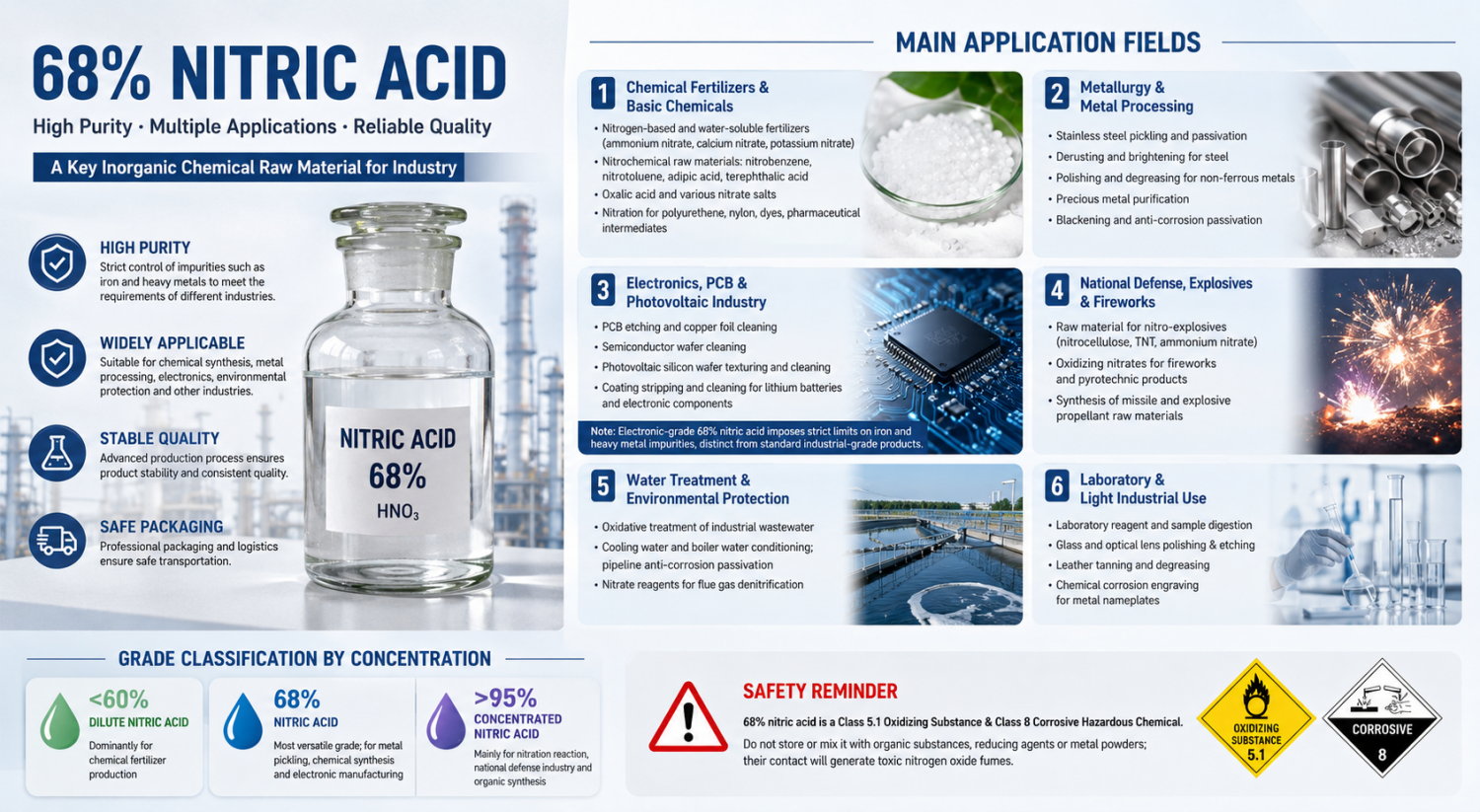
1. Chemical Fertilizers & Basic Chemicals (Largest consumption scenario)
• Produce nitrogen-based and water-soluble fertilizers: ammonium nitrate, calcium nitrate, potassium nitrate
• Synthesize nitrochemical raw materials: nitrobenzene, nitrotoluene, adipic acid, terephthalic acid
• Manufacture oxalic acid and multiple nitrate salts (sodium nitrate, magnesium nitrate, nickel nitrate)
• Conduct nitration reactions for polyurethane, nylon, dyes and pharmaceutical intermediates
2. Metallurgy & Metal Processing
• Stainless steel pickling (plates, pipes, castings): remove oxide scale and complete surface passivation (normally blended with hydrofluoric acid)
• Derusting and brightening for carbon steel and alloy steel
• Polishing and degreasing for non-ferrous metals (copper, aluminum, nickel)
• Precious metal purification (gold, platinum, palladium) for impurity separation
• Blackening and anti-corrosion passivation for steel products
3. Electronics, PCB & Photovoltaic Industry (High-purity grade only)
• PCB etching and copper foil surface cleaning
• Semiconductor wafer cleaning to remove metallic impurities and oxide layers
• Photovoltaic silicon wafer texturing and surface cleaning
• Coating stripping and cleaning for lithium batteries and electronic components
Note: Electronic-grade 68% nitric acid imposes strict limits on iron and heavy metal impurities, distinct from standard industrial-grade products. |
4. National Defense, Explosives & Fireworks
• Raw material for nitro-explosives: nitrocellulose, TNT, ammonium nitrate explosive
• Prepare oxidizing nitrates for fireworks and pyrotechnic products
• Synthesize missile and explosive propellant raw materials
5. Water Treatment & Environmental Protection
• Oxidative treatment of industrial wastewater: decompose organic pollutants and cyanides
• Circulating cooling water and boiler water conditioning; pipeline anti-corrosion passivation
• Produce nitrate reagents for flue gas denitrification
6. Laboratory & Light Industrial Use
• General strong acid reagent for laboratory use; sample digestion for elemental ore and metal analysis
• Glass and optical lens polishing & etching
• Leather tanning and degreasing
• Chemical corrosion engraving for metal nameplates
Grade Classification by Concentration
• <60% (Dilute Nitric Acid): Dominantly for chemical fertilizer production
• 68% Nitric Acid: Most versatile grade; for metal pickling, chemical synthesis and electronic manufacturing
• >95% (Concentrated Nitric Acid): Mainly for nitration reaction, national defense industry and organic synthesis
68% nitric acid is a Class 5.1 Oxidizing Substance & Class 8 Corrosive Hazardous Chemical. Do not store or mix it with organic substances, reducing agents or metal powders; their contact will generate toxic nitrogen oxide fumes.