


All You Need to Know About Potassium Sorbate: A Premium Low-toxic Preservative for Multiple Industries
With the rapid development of the food, daily chemical and pharmaceutical industries, high-efficiency, low-toxic and safe preservatives have become indispensable raw materials for industrial production. As one of the most widely used food-grade preservatives globally, potassium sorbate is favored by downstream manufacturers for its excellent antibacterial performance and high safety profile. To help customers and industry partners fully understand its performance, application scope, safety standards and product advantages, our company releases a full professional guide of potassium sorbate as follows.
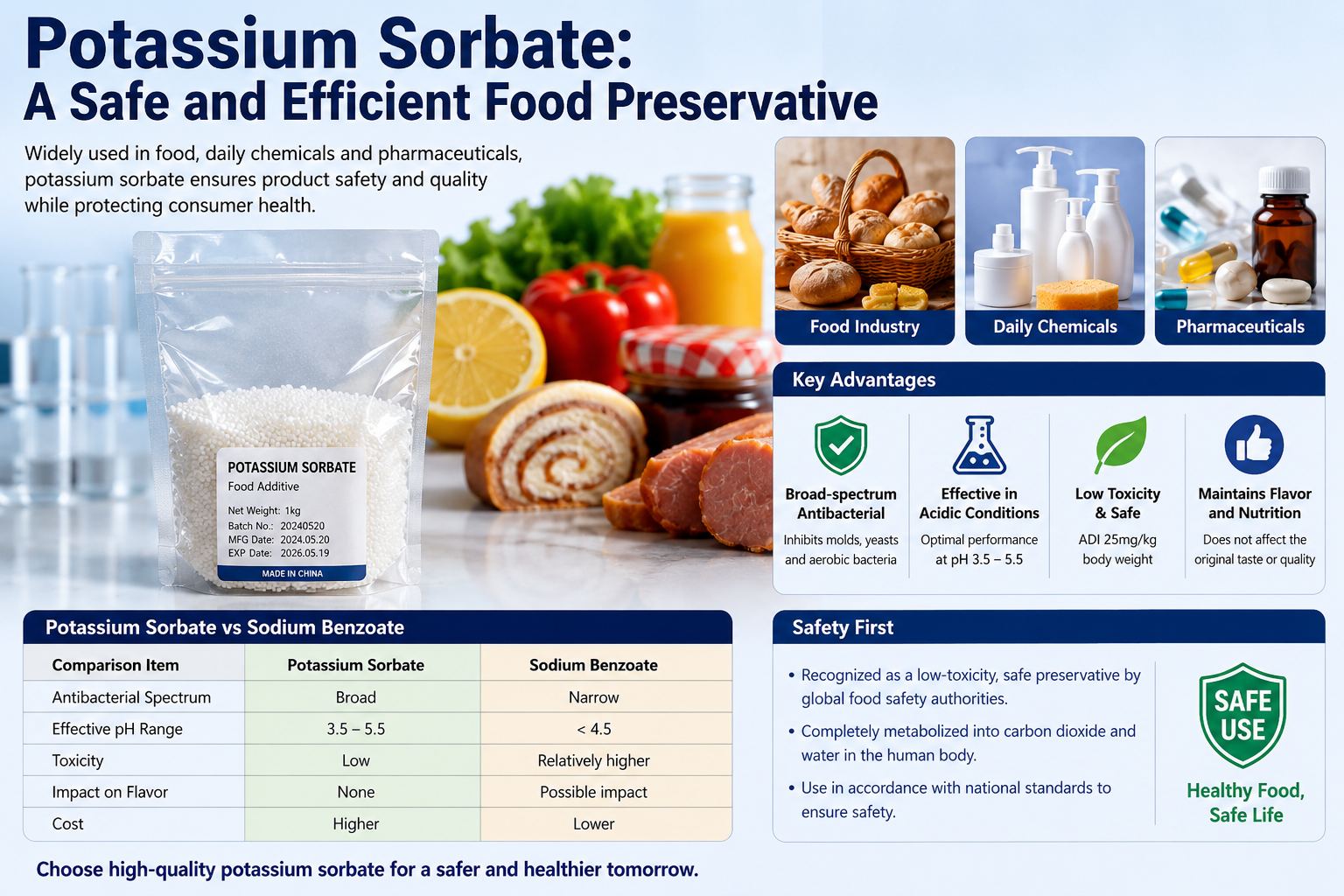
1. Basic Product Information of Potassium Sorbate
Potassium sorbate, with the chemical name trans,trans-2,4-hexadienoic acid potassium, has a molecular formula of C₆H₇KO₂ and a molecular weight of 150.22. Its core physical and chemical properties are listed below:
Solubility: Easily soluble in water (67.6g/100mL at 20℃), soluble in propylene glycol, and slightly soluble in ethanol.
Stability: It maintains good stability against light and heat, with melting and decomposition occurring at approximately 270℃. Notably, its antibacterial activity decreases significantly when the pH value exceeds 6.5.
2. Core Antibacterial Functions and Working Mechanism
2.1 Broad-spectrum Antibacterial Performance
Potassium sorbate delivers prominent inhibitory effects on molds, yeasts and aerobic bacteria including botulinum bacteria and staphylococcus. Meanwhile, it has negligible inhibition on anaerobic bacteria and beneficial bacteria such as Lactobacillus acidophilus, which can effectively protect beneficial flora in products.
2.2 Antibacterial Mechanism
This product inhibits the growth and reproduction of microorganisms by interfering with their internal enzyme systems. It focuses on bacteriostasis rather than sterilization, and will not damage the original flavor, taste and nutritional properties of raw materials during use.
2.3 Applicable pH Environment
The optimal pH range for potassium sorbate is 3.5 to 5.5. It achieves the best antiseptic and fresh-keeping effect in acidic environments.
3. Main Application Scenarios (Food, Daily Chemicals and Pharmaceuticals)
It is widely added in Food Industry, Cosmetics and Daily Chemical Industry as well as Pharmaceutical Industry and Other Fields
It can be used for antiseptic preservation of pharmaceutical preparations including oral syrups and external ointments. Besides, it is also applied in feed processing and food packaging material preservation scenarios.
4. Safety Evaluation: Safe for Human Body Under Standard Dosage
Potassium sorbate is recognized as a low-toxicity safe preservative by global food safety authorities, with complete safety data as follows:
Low toxicity characteristic: The oral LD₅₀ of potassium sorbate in rats is approximately 4920mg/kg, indicating lower toxicity than edible salt.
ADI Safety Standard: The acceptable daily intake (ADI) specified by FAO/WHO is 25mg per kilogram of body weight. For an adult weighing 60kg, the safe daily intake ceiling is 1500mg.
Human metabolism performance: Potassium sorbate can be completely metabolized into carbon dioxide and water in the human body without any substance accumulation. Daily intake through qualified processed food is completely safe for human health.
Potential risks: A small number of crowds may suffer from allergic reactions such as contact dermatitis and skin rashes after exposure. Excessive short-term intake may cause mild gastrointestinal discomfort including nausea and diarrhea and disrupt intestinal flora balance. Long-term high-dose intake may increase liver and kidney metabolic burden, which is extremely rare in daily normal diet scenarios.
5. Comparative Analysis: Potassium Sorbate vs Sodium Benzoate
Sodium benzoate is another common traditional food preservative. The core performance comparison between the two products is shown below:
As one of the most conventional preservatives in the food industry, sodium benzoate is often compared with potassium sorbate. There are obvious differences in antibacterial performance, applicable conditions, safety level and cost between the two ingredients. In terms of comprehensive performance, potassium sorbate features broader-spectrum antibacterial effects, lower toxicity, a wider available pH range and zero adverse impact on the original flavor of end products, while its only drawback is a higher market price. In contrast, sodium benzoate boasts prominent cost advantages and strong antibacterial capacity under strongly acidic environments. However, it has obvious limitations: it only works efficiently when the pH value is below 4.5, carries relatively higher toxicity than potassium sorbate, and has been restricted for use in multiple countries and regions around the globe.
6. Purchasing Guidance and Healthy Consumption Suggestions
6.1 Purchasing Tips for Manufacturers and Consumers
All qualified potassium sorbate products must be marked with complete product information and accurate additive content on packaging labels, complying with national additive limit standards. Customers are advised to choose regular manufacturers with complete qualification certificates for procurement.
6.2 Consumption Advice for Special Groups
Infants, pregnant women and people with allergic constitution are recommended to reduce intake of processed foods containing preservatives as much as possible.
6.3 Daily Diet Principle
Consumers are suggested to prioritize fresh raw food, maintain a balanced and diverse daily diet, and reasonably control the intake of highly processed food to realize healthy eating.
Conclusion
As a mature, safe and high-efficiency preservative, potassium sorbate has irreplaceable application value in food, daily chemical and pharmaceutical industries. Used in strict accordance with national and international safety standards, it will not bring health risks to human bodies. Our company always provides high-purity, standard-compliant potassium sorbate products for global customers, and will continue to popularize additive safety knowledge to promote standardized and healthy development of the whole industry.