


Potassium Sulfate (SOP) vs. Potassium Chloride (MOP): Both Are Potash Fertilizers, But Choosing the Right One Matters
As one of the three essential macronutrients for plant development, potassium plays an irreplaceable role in crop cultivation. Root and tuber crops including sweet potatoes, radishes and potatoes rely heavily on potassium supply, driving farmers to pay greater attention to potassium fertilizers in recent years.
Common potassium fertilizers widely used in farmland include potassium sulfate, potassium chloride and monopotassium phosphate. As a phosphorus-potassium compound fertilizer, monopotassium phosphate is mainly adopted for foliar spraying. This article focuses on potassium sulfate and potassium chloride. Though both serve as potassium sources, they feature distinct properties and application scenarios, and mastering their differences is critical to scientific fertilization.
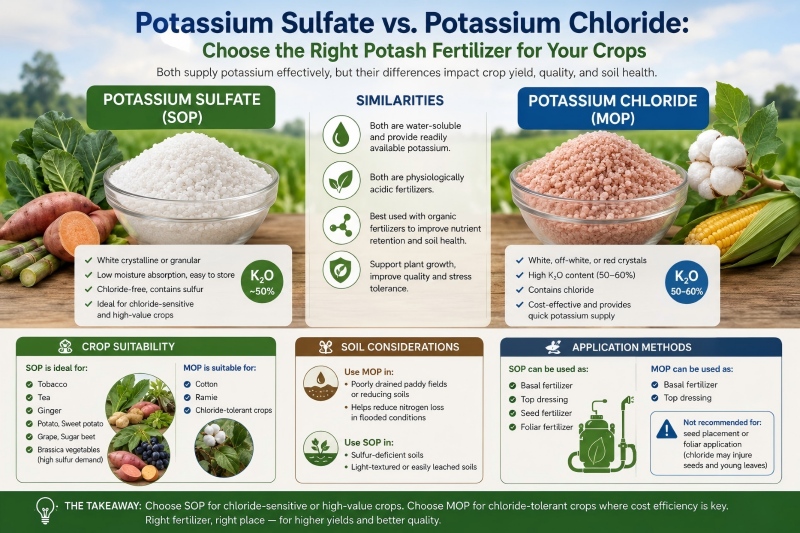
Similarities Between Potassium Sulfate and Potassium Chloride
1. Both fertilizers are fully water-soluble, allowing crops to absorb available potassium rapidly.
2. Both belong to physiologically acidic fertilizers. When applied to acidic soil, they should be used together with alkaline amendments such as calcium magnesium phosphate fertilizer, ammonium bicarbonate and plant ash (yet direct mixing is prohibited), to prevent aggravated soil acidification.
3. Both are inorganic fertilizers. The potassium ions released after application can be adsorbed by soil organic matter. In soils low in organic content, potassium ions are prone to leaching with irrigation water. Therefore, they must be combined with organic manure and appropriate lime to protect soil structure and physicochemical properties.
Core Distinctions Between the Two Fertilizers
1.Potassium Chloride
Manufactured from sylvite, carnallite or extracted as a by-product of sea salt and well salt processing, potassium chloride appears as white or pale yellow crystals; iron impurities may tint it reddish.
It is a high-concentration quick-acting potassium fertilizer with strong hygroscopicity, prone to caking during storage. Canadian potassium chloride products are often blended with around 0.5% red organic additives — non-toxic to soil and crops and biodegradable by soil microbes — forming the red potassium chloride widely recognized by farmers. Its potassium oxide content ranges from 50% to 60%, delivering fast nutrient uptake after application.
2.Potassium Sulfate
Potassium sulfate is manufactured from potassium-bearing sulfate ores or alunite. It appears as white or off-white crystals that dissolve readily in water. Featuring low hygroscopicity, the fertilizer rarely cakes and boasts convenient application, making it an excellent water-soluble fast-acting potash fertilizer.
Free of chloride ions in its composition, potassium sulfate fits a wide range of planting scenarios. It works well for all chloride-sensitive crops, delivering remarkable yield boosts while effectively elevating the quality of agricultural produce.
Visual Identification of Potassium Sulfate and Potassium Chloride
Potassium sulfate exists as white crystals or coloured granular crystals with weak hygroscopicity, resisting caking during storage while remaining fully soluble in water.
Potassium chloride forms white or pale yellow crystals, occasionally reddish due to iron salts, and dissolves easily in water as a fast-acting high-potassium fertilizer. Farmers can first distinguish the two products by observing their physical appearance based on the above characteristics.
Divergent Application Rules
1. Suitable Crop Varieties
Potassium chloride contains chloride ions. Applied to ramie and cotton fields, it boosts yields and improves fibre quality. However, chloride-sensitive crops (chloride-avoidant crops) such as tea trees, tobacco and ginger suffer quality losses: reduced aromatic flavour and poorer combustibility in tobacco leaves. Chloride ions also harm sugar beets, potatoes, sweet potatoes and grapes, cutting both output and commodity quality.
If potassium chloride must be used on chloride-sensitive crops, it shall be mixed and composted with organic manure as base fertilizer or applied well in advance of planting.
Potassium sulfate is chlorine-free with a far broader application scope. It delivers superior results on all chloride-avoidant crops including tobacco, sweet potatoes and sugarcane, as well as sulfur-loving brassica crops.
2. Adaptable Soil Types
Potassium sulfate is not recommended for poorly drained, highly reductive paddy fields or paddies applied with large amounts of unrotted organic manure. Under such conditions, sulfate ions may be reduced into hydrogen sulfide, which poisons crop root systems.
For these problematic paddy soils, potassium chloride is the better option. Chloride ions leach downwards into subsoil layers in flooded paddies, eliminating adverse impacts on crops. Additionally, chloride inhibits nitrosomonas in soil, cutting nitrogen loss caused by nitrification and denitrification of ammonium nitrogen fertilizers. Overall, potassium chloride outperforms potassium sulfate in highly reductive rice paddies.
By contrast, potassium sulfate is ideal for sulfur-deficient soils, such as waterlogged muddy paddies and cold waterlogged fields.
Supplementary Tip for Cotton Cultivation
Potassium fertilizers strengthen cotton’s stress resistance and disease resistance, hence insect-resistant cotton varieties require increased potassium input. Blind overuse of nitrogen and phosphate fertilizers while neglecting potassium not only raises farming costs but also triggers premature aging or delayed ripening in cotton, severely damaging yield and fibre quality.