


The Key Role of Potassium Nitrate in Fireworks and Firecrackers
Potassium nitrate, with the chemical formula KNO₃, is a white crystalline or powdery inorganic compound featuring high water solubility and strong oxidizing properties. As a core oxidant raw material for fireworks and firecrackers, it plays an indispensable role in the combustion reaction of pyrotechnic products. This news article elaborates on its six core functions in fireworks manufacturing and combustion.
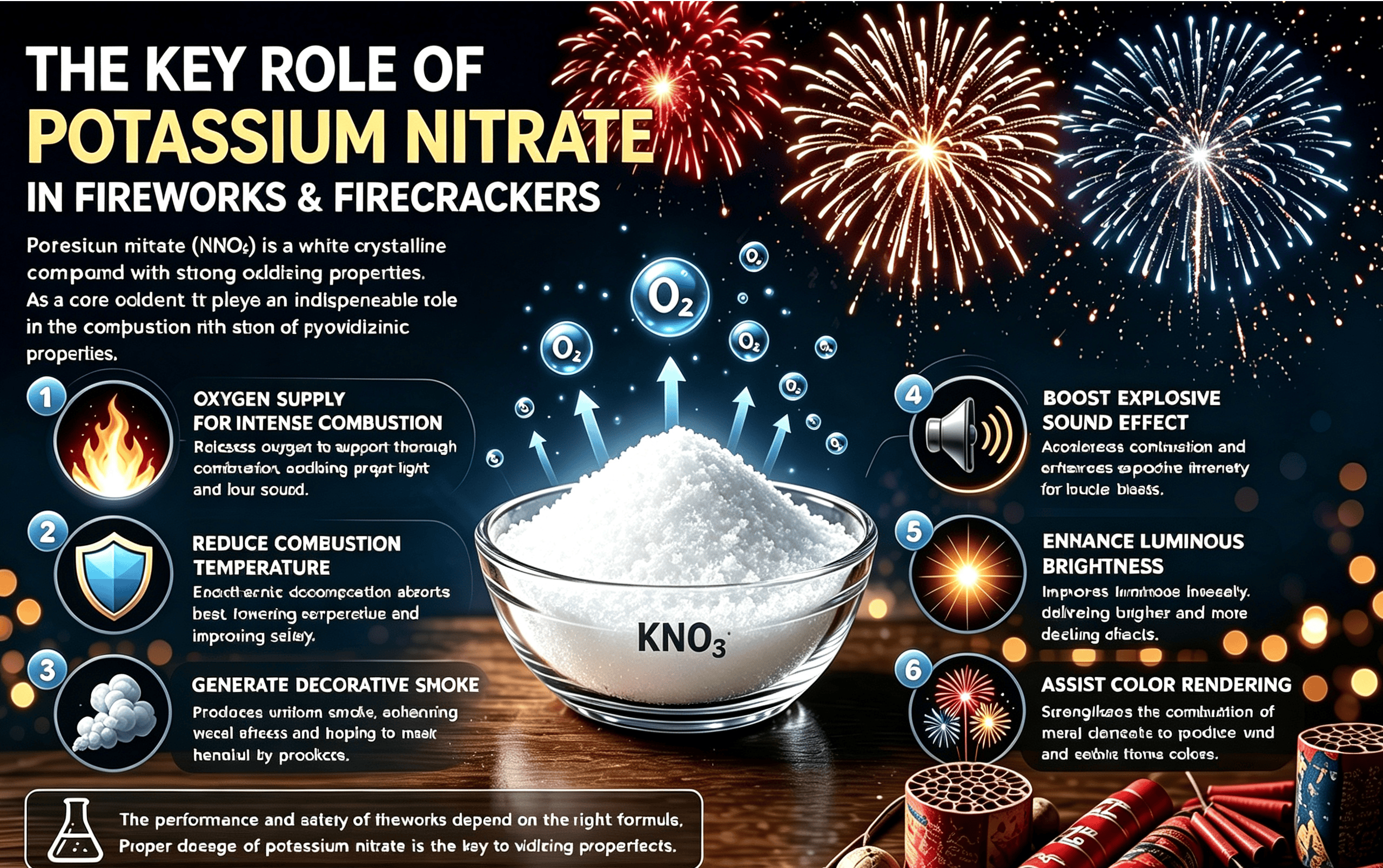
Core Functions of Potassium Nitrate in Fireworks and Firecrackers
1. Oxygen Supply for Intense Combustion
Potassium nitrate decomposes and releases a large amount of oxygen during fireworks combustion. Oxygen is an essential condition for the normal burning of pyrotechnic products. Sufficient oxygen supports thorough and intense combustion of internal combustibles, laying a foundation for loud sound, bright light and other visual and auditory effects of finished fireworks.
2. Reduce Combustion Temperature for Safety Control
The oxygen decomposition reaction of potassium nitrate is endothermic, which can effectively absorb partial heat generated by combustion and lower the overall combustion temperature. This function avoids accidental overheating and spontaneous explosion of fireworks, improves production and use safety, and also moderately prolongs the stable combustion duration of products.
3. Generate Decorative Smoke
The oxygen released by potassium nitrate reacts fully with other combustion ingredients inside fireworks, producing uniform smoke. The smoke can enrich the viewing effect of fireworks performances. Meanwhile, it can partially cover harmful gas by-products produced during pyrotechnic combustion, optimizing the overall viewing experience.
4. Boost Explosive Sound Effect
Adequate oxygen released by potassium nitrate accelerates combustion speed and enhances explosive intensity, thus generating louder blast sound. The sound volume of fireworks is positively correlated with the dosage of potassium nitrate: within a reasonable formula range, higher potassium nitrate content brings louder and more powerful sound effects.
5. Enhance Luminous Brightness
Intense combustion promoted by potassium nitrate significantly improves the luminous brightness of fireworks. Similarly, the luminous intensity is proportional to the additive amount of potassium nitrate. Reasonable dosage matching can help fireworks present brighter and more dazzling luminous effects.
6. Assist Color Rendering (No Direct Color Generation)
It is worth noting that potassium nitrate cannot produce flame colors independently. Instead, its released oxygen strengthens the combustion reaction of various metal color-developing elements added in fireworks formulas. It helps metal elements fully burn and stably present vivid and saturated specific flame colors.
Summary
As a fundamental oxidizing raw material, potassium nitrate undertakes multiple key missions in fireworks: supplying combustion oxygen, controlling combustion temperature, producing smoke, enhancing sound and luminous effects, and assisting flame color development. Its additive dosage directly determines the safety performance, combustion duration and final viewing effects of fireworks and firecrackers. Strict formula proportion control of potassium nitrate is critical for both product performance and use safety of pyrotechnic products.