


Core Applications & Differences from Sodium Tripolyphosphate (STPP) and Sodium Hexametaphosphate (SHMP)
Sodium hexametaphosphate (SHMP), also known as Graham’s salt, is a versatile polyphosphate additive with excellent chelating, dispersing and stabilizing properties, widely applied in food processing and various industrial fields. This news brief focuses on its core applications and key application differences compared with sodium tripolyphosphate (STPP).
1. Core Applications of Sodium Hexametaphosphate
1.1 Food Industry
Food preservation: Inhibits microbial growth to extend shelf life; presents better antibacterial effect when compounded with potassium sorbate.
Meat water retention: Adjusts meat pH value to improve water holding capacity and keep meat tender, commonly compounded with other phosphates for meat and seafood products.
Thickening & fresh-keeping: Prevents discoloration of soy sauce and bean paste, shortens fermentation period; improves crispness of pickled vegetables.
Antioxidation & color protection: Chelates metal ions to avoid vitamin oxidation and beverage discoloration, stabilizing natural pigments in canned fruits and vegetables.
Baking & ice cream production: Optimizes dough ductility; enhances ice cream expansion degree and taste fineness.
Beverage & dairy stabilization: Clarifies beer and prevents turbidity; avoids fat separation and gel precipitation in dairy products.
1.2 Industrial Industry
Water treatment: Acts as water softener and scale inhibitor to remove scale in boiler and circulating water; also serves as auxiliary softener in textile printing and dyeing.
Papermaking: Disperses pulp fillers and fibers to ensure uniform paper quality.
Metal protection: Forms protective films on metal surfaces to reduce equipment corrosion.
Coatings & refractory materials: Improves coating viscosity and high-temperature peeling resistance of refractory products.
Detergent auxiliary: Enhances detergency by dispersing dirt and softening hard water.
Mineral flotation: Depresses gangue minerals and disperses ore slime. Note: SHMP is hygroscopic, so flotation solution shall be prepared and used on the same day.
Construction & oil drilling: Retards concrete solidification to avoid cracks; adjusts drilling mud viscosity for better fluidity.
Besides, SHMP can react with sodium fluoride to produce sodium monofluorophosphate, a vital industrial raw material.
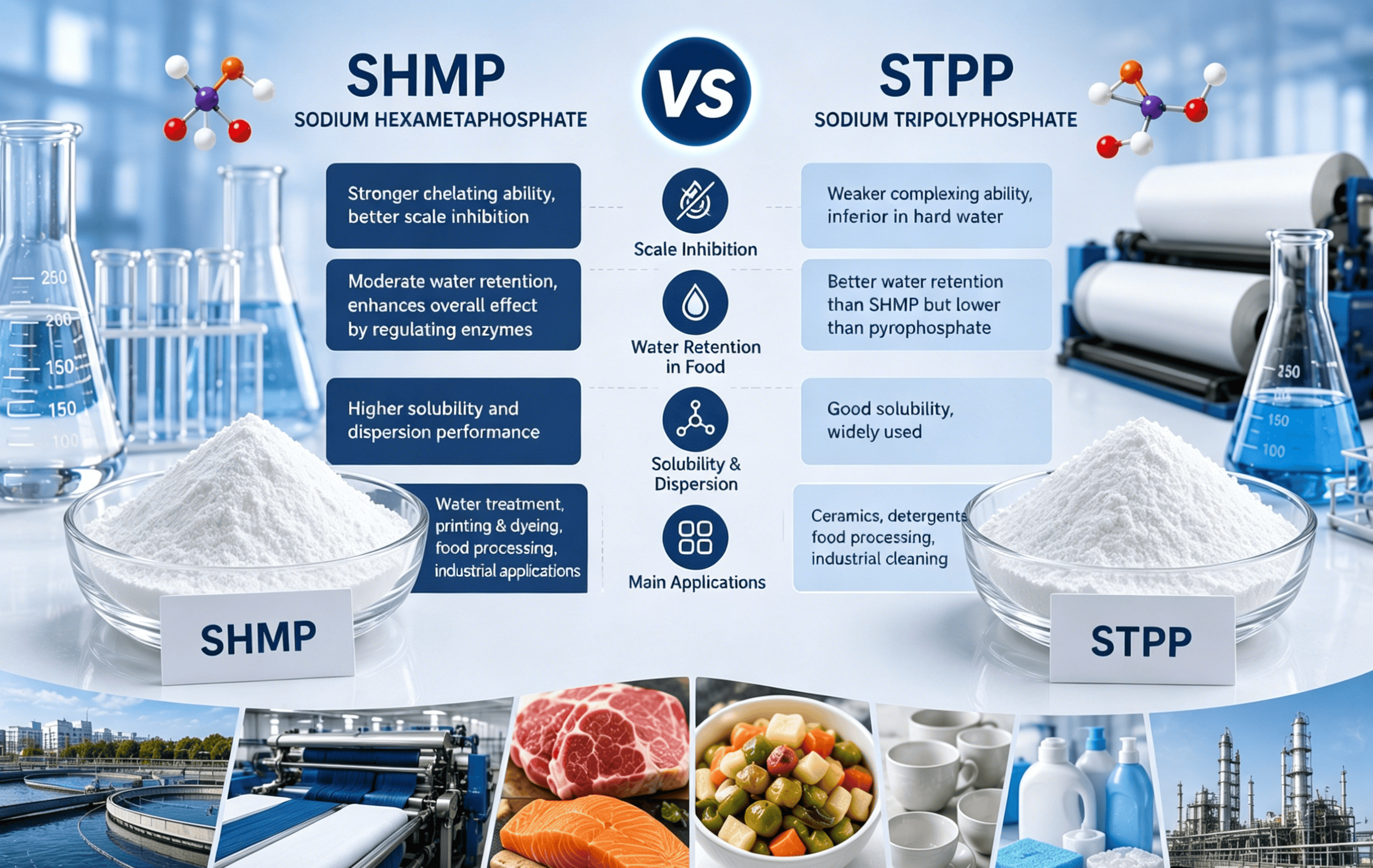
2. Key Differences Between SHMP and STPP
Both two phosphates can be hydrolyzed in water, but they are used in different industrial scenarios: SHMP is mainly used for water treatment and printing & dyeing, while STPP is more popular in ceramics and detergent manufacturing.
2.1 Scale Inhibition Performance
SHMP has stronger metal ion chelating capacity, better solubility and dispersion performance, featuring more outstanding scale inhibition effect. STPP has weaker complexing ability, with inferior scale prevention effect in hard water.
2.2 Water Retention Effect in Food
The water retention capacity for meat and seafood follows the order: sodium pyrophosphate > STPP > SHMP. The three phosphates are usually used in combination. They work in different mechanisms: sodium pyrophosphate improves meat water retention directly; STPP hydrolyzes into pyrophosphate; SHMP boosts the overall water retention effect by regulating enzyme activity.
Conclusion
As a multi-functional phosphate additive, SHMP has irreplaceable advantages in food processing and industrial production. Enterprises can select single phosphate or compound phosphate products according to actual production demands to improve production efficiency and product quality.