


How to Distinguish TSPP and SAPP – Professional Guide from Manufacturer
Although sodium pyrophosphate (TSPP) and sodium acid pyrophosphate (SAPP) share similar names, they differ greatly in core chemical properties and applicable scenarios. Enterprises and buyers can quickly tell them apart by sorting out their key distinguishing points.
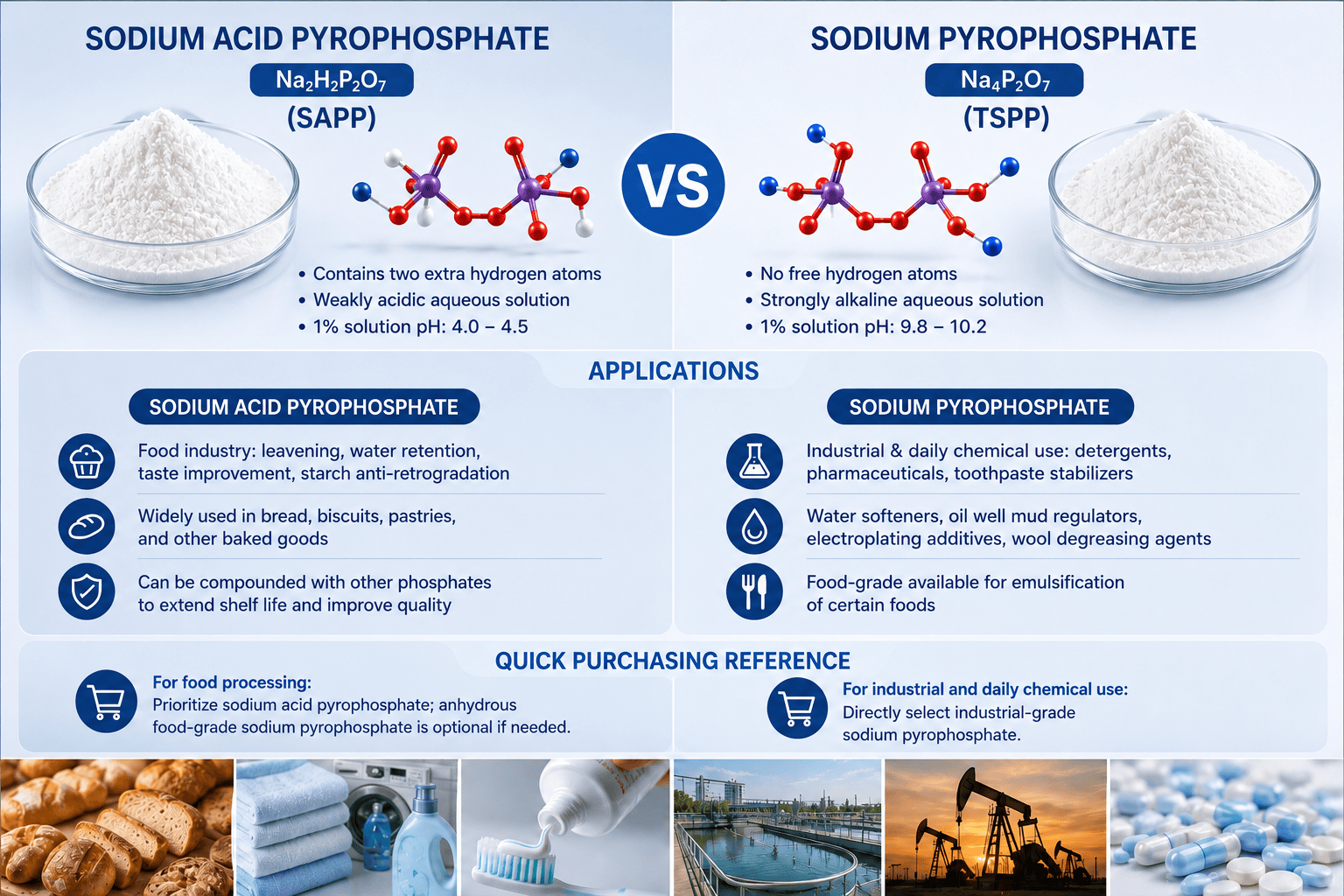
Sodium acid pyrophosphate, also known as disodium dihydrogen pyrophosphate, has the chemical formula Na₂H₂P₂O₇.
Sodium pyrophosphate, also called tetrasodium pyrophosphate, has the chemical formula Na₄P₂O₇.
Structurally, sodium acid pyrophosphate contains two extra hydrogen atoms compared with sodium pyrophosphate, which determines their fundamental property gaps. Due to ionizable hydrogen atoms, its aqueous solution is weakly acidic; a 1% aqueous solution has a pH value ranging from 4.0 to 4.5, hence the name "acid-type".
By contrast, sodium pyrophosphate is a fully neutralized normal salt without free hydrogen atoms, and its aqueous solution presents strong alkalinity, with the pH value of a 1% solution between 9.8 and 10.2.
2. Distinct Applications Derived from Property Differences
Sodium Acid Pyrophosphate
It is mainly applied in the food industry, featuring leavening, water retention, taste improvement and starch anti-retrogradation functions. Widely used in baked goods such as bread, biscuits and pastries, it reacts slowly with sodium bicarbonate to release carbon dioxide, making dough fluffy with uniform internal texture. It can be compounded with other phosphates to extend food shelf life and upgrade product quality.
Sodium Pyrophosphate
Its primary markets cover industrial and daily chemical sectors, including detergents, pharmaceutical raw materials, stabilizers for toothpaste, water softeners, oil well mud regulators, electroplating additives and wool degreasing agents. Food-grade sodium pyrophosphate is available for emulsification treatment of certain foods, yet industrial-grade products account for the major market share.
Quick Purchasing Reference
For food processing: Prioritize sodium acid pyrophosphate; anhydrous food-grade sodium pyrophosphate is optional if needed.
For industrial and daily chemical use: Directly select industrial-grade sodium pyrophosphate.
As a professional source manufacturer, Reapchem owns a technical service team to match grade-specified products for clients accurately. Feel free to leave a message below or visit our online store for purchasing inquiries.