


Brief News Report (English Version) China’s State Council Decree No. 839 Comes into Force, Classifying Phosphate Rock as a Strategic National Resource
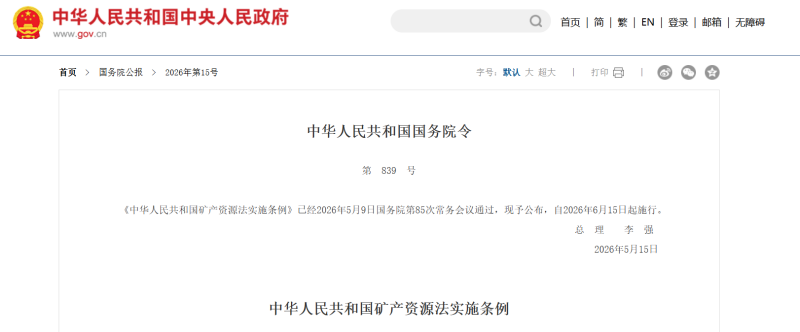
The Regulations for the Implementation of the Mineral Resources Law of the People's Republic of China (State Council Decree No. 839) issued by the State Council in June 2026 have officially taken effect. Phosphate rock, together with lithium, rare earths and another 33 mineral varieties, has been designated as one of China’s 36 strategic mineral resources, subject to full-chain regulation covering exploration, mining, supply, sales and reserves.
1. Strategic Importance of Phosphate Rock
As an irreplaceable raw material, phosphate rock supports both food security via phosphate fertilizers and the new energy sector as a core feedstock for lithium iron phosphate and basic chemical products. Phosphorus cannot be artificially synthesized. China faces shortages of high-grade phosphate rock with limited mine reserve service life. Surging demand from the new energy industry has further amplified its scarcity.
2. Three Core Functions of Full-chain Coordinated Regulation
First, stringent controls on mining and exports will safeguard national resource security. Second, higher industrial thresholds will phase out small, backward enterprises and concentrate mineral resources among leading manufacturers. Third, coordinated supply adjustment will strengthen China’s pricing power in the global phosphate industry.
3. Future Industry Trends
Prices of high-grade phosphate rock will remain elevated with periodic fluctuations. Tighter approval procedures for mining rights will accelerate industrial consolidation. The global phosphate market will shift toward a seller’s market, boosting China’s international industrial influence.
4. Development Requirements
Enterprises must balance stable supply, environmental protection and resource conservation. The sector will invest heavily in technologies for low-grade ore utilization and phosphorus recycling. Local authorities will standardize mining operations to coordinate food security and new energy industrial development, reinforcing China’s competitive edge in global mineral resources.